

How Synnoema Works
Synnoema provides a way of representing experiences while also keeping track of what develops across them over time.
At its simplest, the framework includes several kinds of representation:
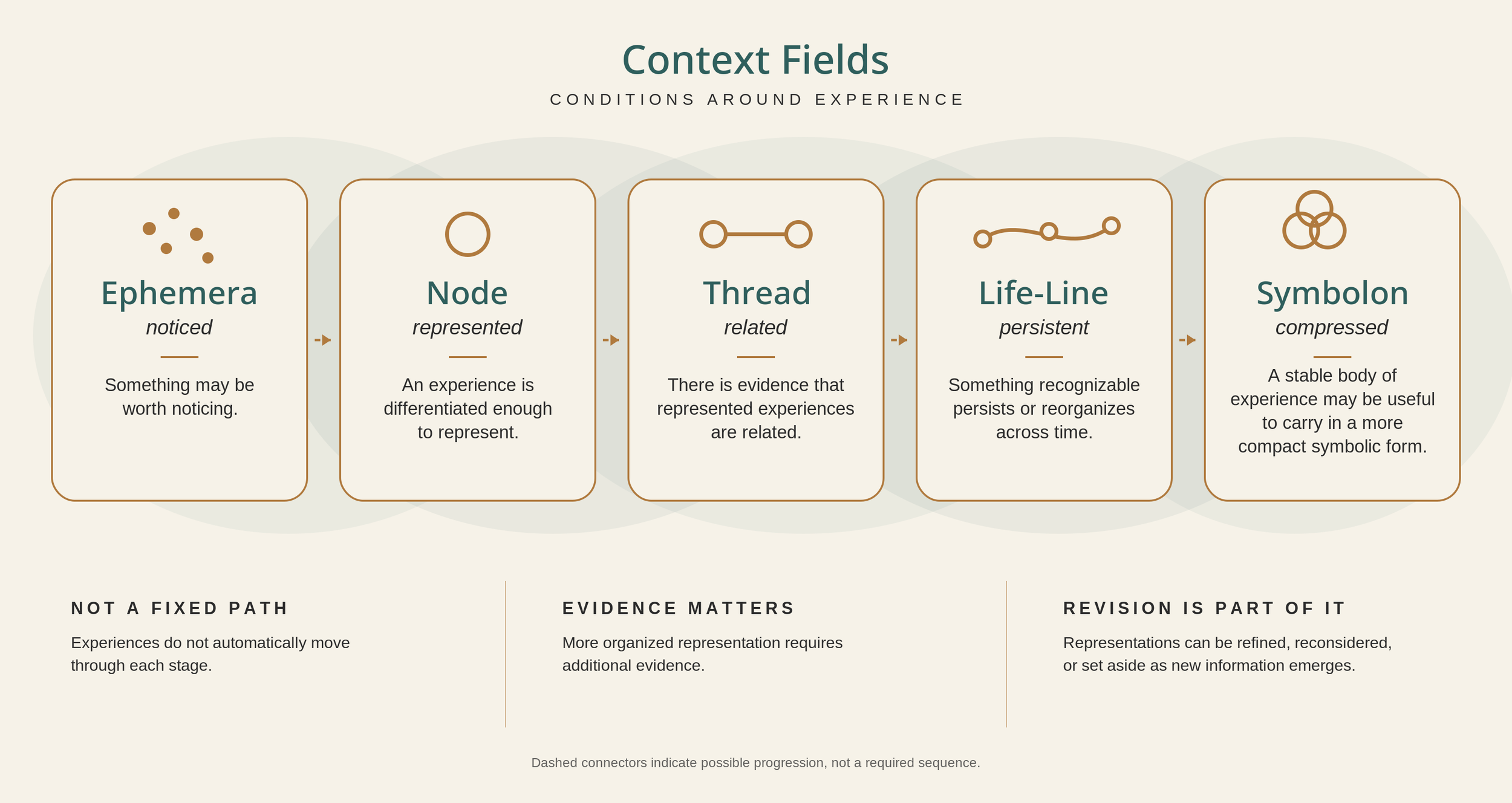
Ephemera → Node → Thread → Life-Line → Symbolon
The arrow is useful as a general orientation, but it can also be misleading if it suggests that every experience is supposed to travel through these stages. That's not how Synnoema works. Each part of the framework represents something different, and moving toward a more organized representation requires additional evidence.
Ephemera
Experience produces a great deal of information, much of which may never become important.
Someone might notice an unusual reaction during a conversation, a recurring image, a change in attention, a bodily sensation, or something else that seems worth noticing. At that point, there may be no reason to decide exactly what it is.
Ephemera provides a way of noticing possible signals before deciding that they represent something stable.
This is intentionally a low-commitment part of the framework. Something can be noticed without needing to become anything more.
Node
A Node is a bounded unit of experience that has become differentiated enough to represent explicitly.
Suppose someone describes a moment during a conversation when their mind suddenly became blank or “white.” Their ordinary thinking and ability to respond were disrupted for a short period, and the experience felt noticeably different from what was happening immediately before and afterward.
There may be enough differentiation there to consider representing the experience as a Node.
That still doesn't explain it.
A Node doesn't tell us why the experience happened, what it symbolizes, whether it reflects a psychological condition, or whether it will happen again. It preserves the fact that something became experientially distinct enough to represent.
One of the questions I'm currently working on is exactly how much evidence should be required before making that move.
Thread
A Thread represents a stable relationship between two or more Nodes.
This is an important distinction. A Thread isn't simply a collection of similar experiences, and it isn't an explanation for why those experiences occurred.
Instead, it records evidence that a relationship between Nodes persists.
For example, two Nodes might repeatedly occur together, tend to appear in a particular sequence, or remain related across different situations. If that relationship is sufficiently stable and distinguishable from coincidence or noise, Synnoema can represent the relationship as a Thread.
The Thread still doesn't tell us what the relationship means.
It tells us that there is enough evidence to take the relationship seriously.
Life-Line
Some configurations persist or reorganize across much longer periods of time.
A Life-Line represents that kind of longitudinal pattern.
Life-Lines require considerably more restraint because they make claims about endurance across time. A pattern that appears in one conversation, one period of someone's life, or one collection of experiences shouldn't automatically become a Life-Line.
There needs to be evidence that something has persisted, recurred, or reorganized across a meaningful span of time.
A Life-Line might also survive changes in context. Something recognizable may continue to appear across different relationships, roles, or periods of life even though its local expression changes.
Importantly, a Life-Line isn't a life story.
It doesn't say that a person's life is “about” something, and it isn't intended to define identity or establish a developmental narrative. It simply represents evidence that some organization of experience has endured or changed in a patterned way over time.
Symbolon
Sometimes a well-established pattern can eventually be represented in a much more compact form.
Synnoema calls this a Symbolon.
A Symbolon might be a word, phrase, image, metaphor, or emblem that allows a complicated body of experience to be referenced without having to reconstruct the entire map each time.
But Symbolons are optional, and they have a particularly high threshold.
They are intended to compress something that has already become sufficiently stable. They shouldn't be used to create coherence where the underlying information remains unsettled.
For that reason, a Symbolon isn't simply the final stage of Synnoema.
It is better understood as a reversible form of symbolic compression. If it stops being useful or begins to imply more than the underlying information supports, it can be revised or set aside without changing the structures underneath it.
Context Fields
Context matters throughout this process, but Synnoema treats context somewhat differently from the structures above.
A Context Field is a bounded, permeable contextual configuration that can affect how experiences become salient, how relationships appear, and how patterns stabilize.
For example, the organization of someone's experience may look different depending on a relationship, role, environment, or other contextual condition.
The important point is that a Context Field isn't another step in the sequence.
It doesn't contain Nodes or Threads, and it doesn't explain why they exist. Instead, it helps represent the conditions under which those structures appear and behave.
Multiple Context Fields can overlap, change, or coexist. A longer-running pattern may also remain recognizable across different Context Fields even though its expression changes from one context to another.
So a better picture of Synnoema is not simply:
Ephemera → Node → Thread → Life-Line → Symbolon
but rather that progression occurring under the influence of Context Fields that condition what is happening across the map.
The map can stop
There is no requirement that information move toward increasingly elaborate representation.
Something noticed as Ephemera may never become a Node.
A Node may never participate in a stable Thread.
A possible relationship may remain unresolved.
A Thread may never contribute to a Life-Line.
And a Life-Line may never need a Symbolon.
That's intentional.
Sometimes the most accurate conclusion is that there isn't enough evidence to go any farther.
The map can also change
Synnoema assumes that later information can change an earlier understanding.
A relationship that initially looked stable may become less convincing. Experiences that seemed related may need to be separated. A longer-running pattern may need to be narrowed or reconsidered.
The goal isn't to protect the existing map from revision.
It's to preserve enough information that we can see what changed and why our understanding changed with it.
What the framework is really keeping track of
The terminology can make Synnoema look more complicated than the basic idea actually is.
At each point, I'm trying to keep track of a different kind of claim:
Something may be worth noticing.
An experience is differentiated enough to represent.
There is evidence that represented experiences are related.
Something recognizable persists or reorganizes across time.
A stable body of experience may be useful to carry in a more compact symbolic form.
Context Fields can affect all of these without automatically explaining any of them.
The important part isn't reaching the end of the sequence. It's being able to tell what the available information actually supports at any particular point.